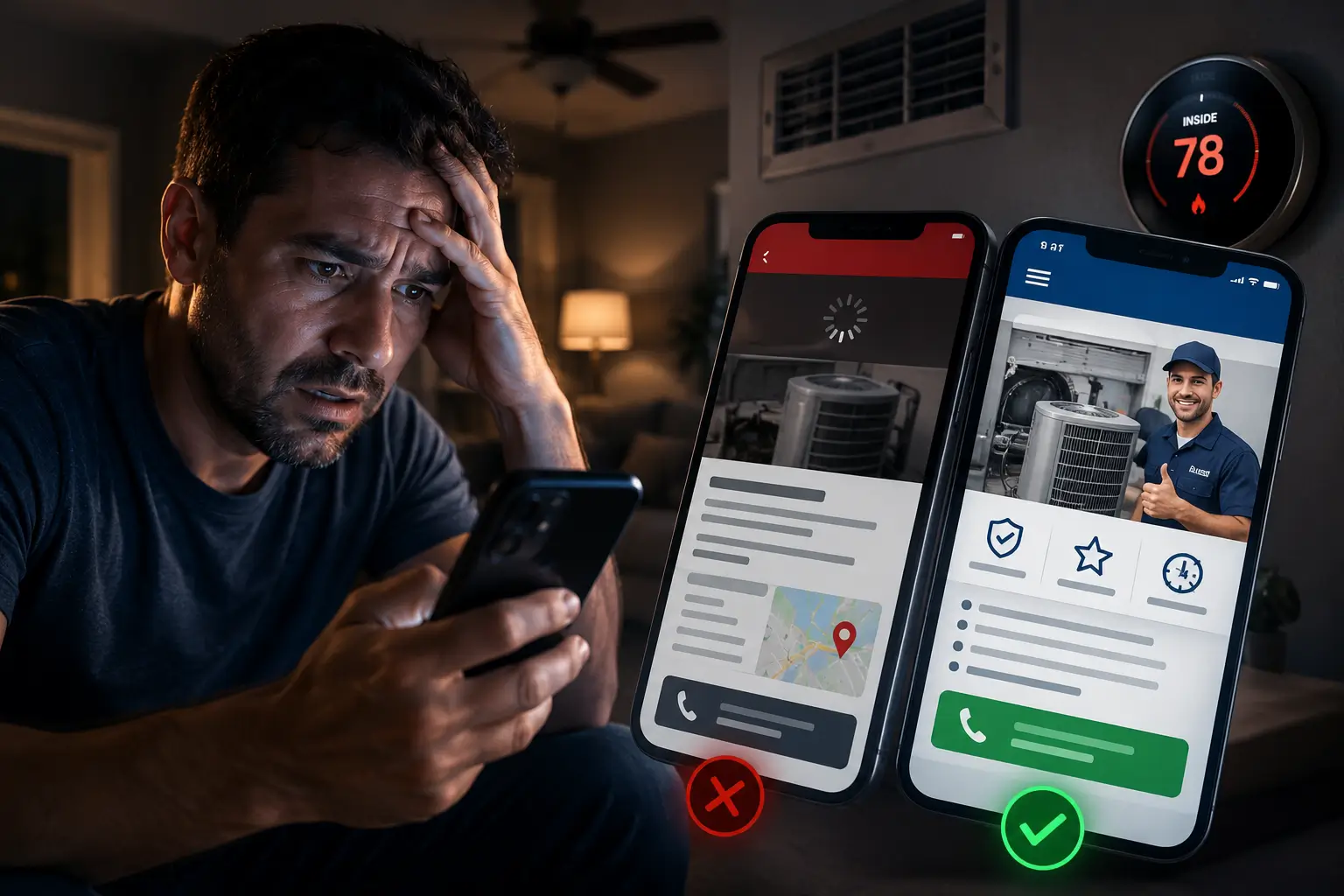

Someone searches Google for AC repair.
They click your website.
They check your reviews, services, financing options, or pricing information.
Then they leave.
Maybe they’re comparing another HVAC company. Maybe they get distracted. Maybe they’re simply not ready to schedule yet.
Without a follow-up strategy, that potential customer may never see your company again.
That’s where HVAC retargeting comes in.
HVAC retargeting ads help you advertise specifically to people who have already visited your website or interacted with your business but haven’t converted yet.
Instead of spending your entire advertising budget reaching strangers, retargeting gives you another opportunity to reach people who already know your company exists.
But there’s an important catch:
Retargeting only works well when you target the right visitors, show them the right message, and send them back to a website that makes it easy to take action.
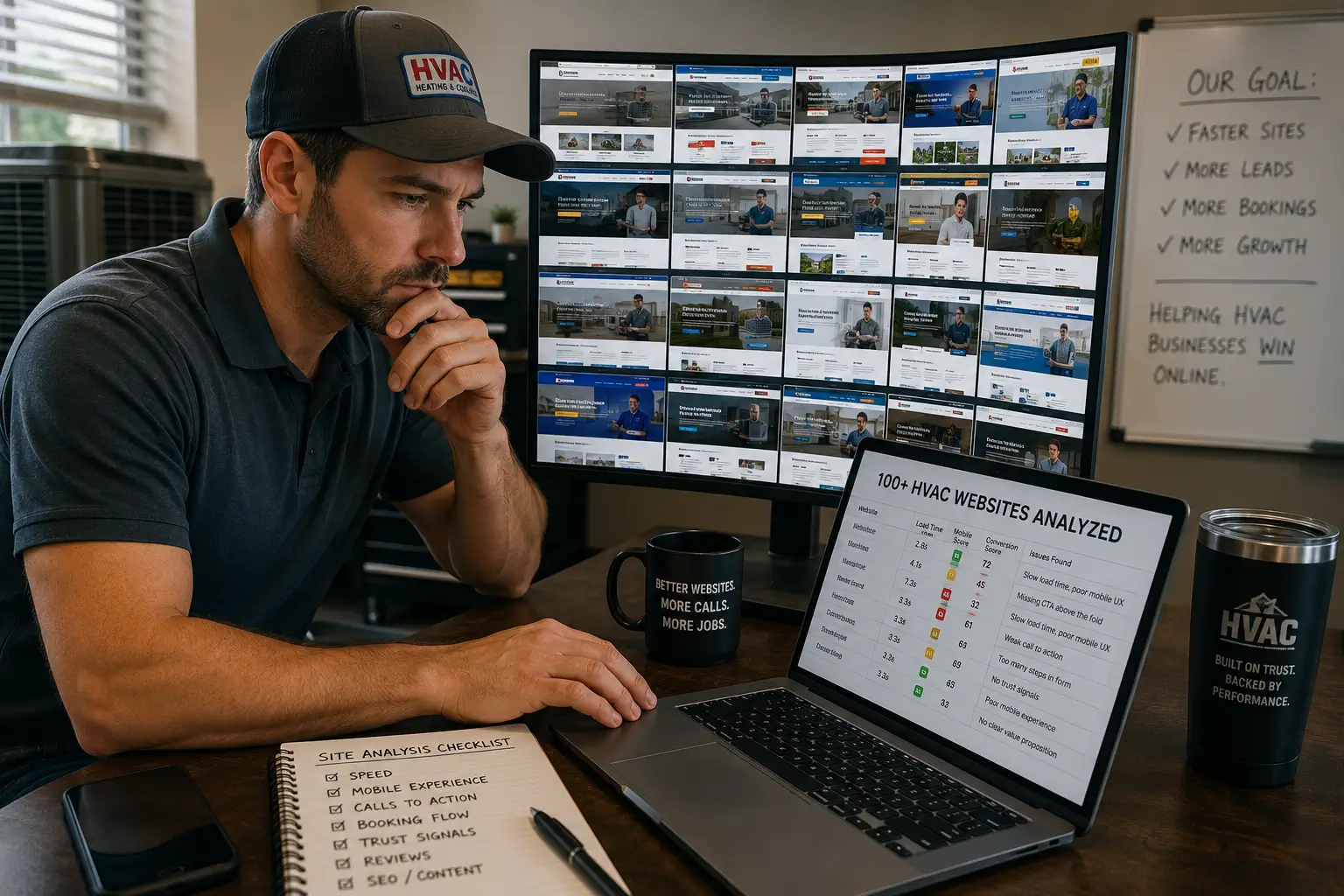
If your website already gets traffic but isn’t producing enough calls or bookings, you may have a bigger conversion problem. I found the same patterns repeatedly after analyzing more than 100 HVAC websites.
Let’s look at how HVAC retargeting actually works and when it’s worth using.
HVAC Retargeting Ads: How to Bring Back Website Visitors Who Didn’t Call (Full Episode)
What Is HVAC Retargeting?
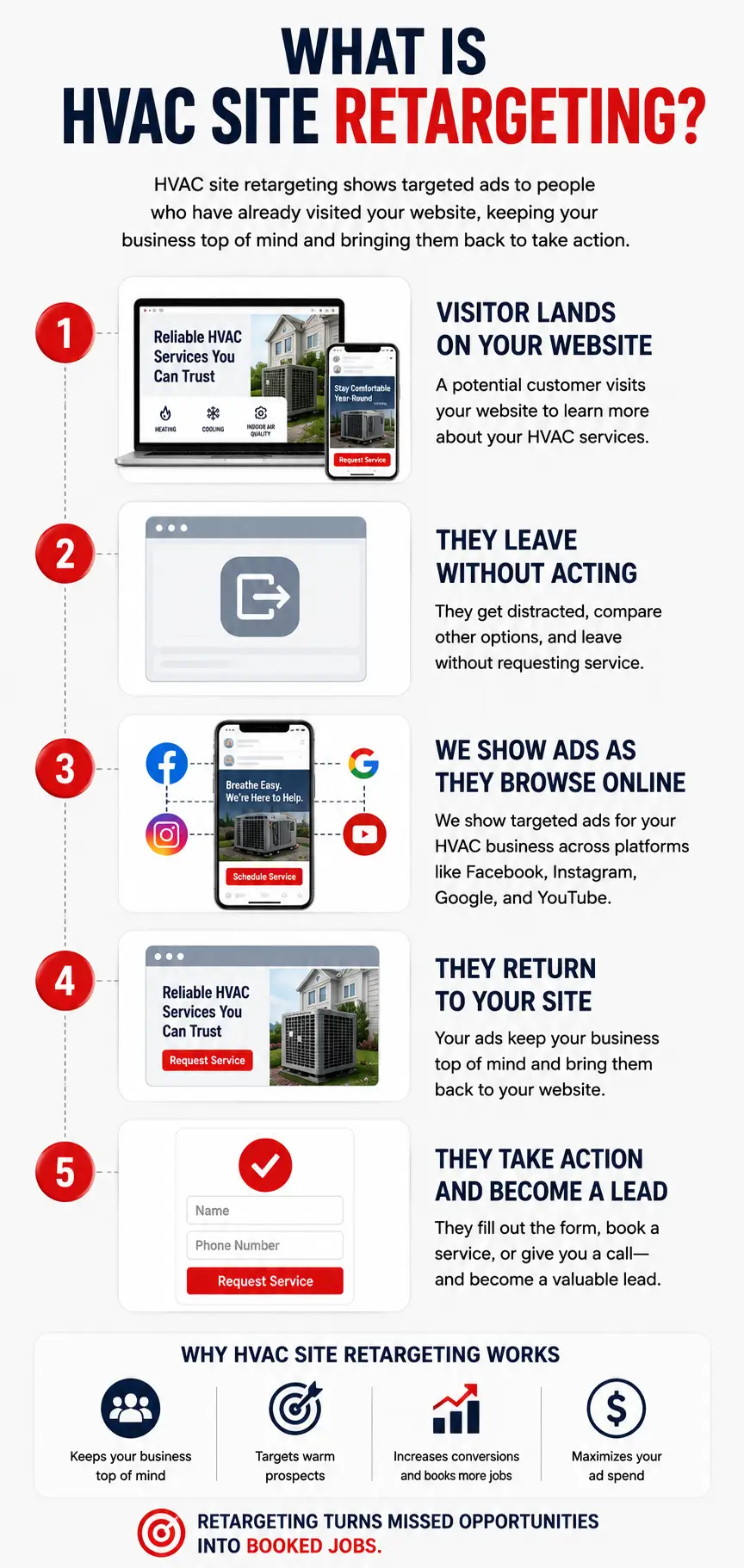
HVAC retargeting is a paid advertising strategy that reconnects your company with people who previously visited your website.
For example:
A homeowner searches for:
“AC replacement near me”
They visit your AC replacement page but don’t request an estimate.
Later, they may see an ad from your company while browsing Facebook, Instagram, YouTube, Google, or other websites.
Instead of disappearing after one visit, your HVAC company stays visible while that homeowner continues comparing options.
You’ll also hear this strategy called HVAC remarketing.
The terminology varies between advertising platforms, but the business objective is essentially the same:
Re-engage people who have already interacted with your company and give them another reason to take action.
How HVAC Website Retargeting Works
A basic HVAC retargeting system looks like this:
1. A homeowner visits your website
They may arrive from Google Search, Local Services Ads, social media, organic search, or another marketing channel.
2. Their visit becomes part of an advertising audience
Platforms such as Google Ads and Meta can create audiences based on previous website activity when the required tracking and consent systems are properly configured.
3. Visitors who didn’t convert see another message
Instead of showing everyone the same generic HVAC ad, you can tailor the message around what they were interested in.
4. The visitor returns
The ad sends them back to an appropriate service page or landing page.
5. The website gets another opportunity to convert them
That might mean:
- A phone call
- An estimate request
- An online booking
- A financing application
- A form submission
Retargeting isn’t creating demand from nothing.
It’s giving existing demand another chance to convert.
When Does HVAC Retargeting Make Sense?

Retargeting is most useful when your website already receives qualified visitors who frequently leave without contacting you.
It can be especially useful for higher-consideration HVAC services such as:
- System replacement
- New HVAC installation
- Heat pumps
- Indoor air quality systems
- Commercial HVAC
- Maintenance plans
- Financing-driven purchases
Someone with a completely dead AC unit may call quickly.
Someone considering a $10,000+ HVAC replacement might visit several companies, read reviews, compare brands, explore financing, and discuss the purchase before making a decision.
Those are very different buying journeys.
Your retargeting strategy should reflect that.
However, if you’re already paying for traffic and your website struggles to convert visitors in the first place, adding more advertising isn’t always the right first move.
That’s why I recommend checking these HVAC website problems before spending more money on ads.
The 5 HVAC Audiences Worth Retargeting
Don’t automatically retarget every website visitor with the same advertisement.
Segment visitors based on what they actually did.
1. Service Page Visitors
Someone who visits your AC replacement page has demonstrated more specific intent than someone who only reads a generic blog post.
Create audiences around your most commercially valuable service pages.
For example:
Visited: AC Replacement
Didn’t: Submit estimate request
Retarget with: Replacement, financing, warranty, or free-estimate messaging.
2. Financing Page Visitors
A homeowner who looks at financing information may be seriously considering a larger purchase.
Instead of serving another generic brand advertisement, address the decision they’re currently making.
Examples:
- Financing options available
- Flexible payment options
- Replacement estimates
- Warranty information
- Energy-efficiency benefits
3. Visitors Who Started but Didn’t Complete a Conversion
These can be some of your most valuable visitors.
Examples include people who:
- Opened a booking form
- Started scheduling
- Visited your contact page
- Clicked toward financing
- Interacted with an estimate form
They came close to converting.
Your goal is to remove whatever stopped them.
4. Repeat Website Visitors
Someone who visits your company multiple times is sending a stronger intent signal than someone who accidentally opened one page and immediately left.
Repeat visitors can justify more focused messaging around:
- Reputation
- Reviews
- Availability
- Financing
- Guarantees
- Free estimates
- Scheduling
5. Previous Customers
Retargeting isn’t limited to new leads.
Existing customers may be relevant audiences for:
- Seasonal tune-ups
- Maintenance memberships
- Indoor air quality services
- System upgrades
- Complementary HVAC services
Just make sure your messaging makes sense for existing customers rather than treating them like strangers.
Google vs. Meta Retargeting for HVAC
You don’t necessarily have to choose only one platform.
They can serve different roles.
Google Ads
Google can help reconnect with previous website visitors across parts of its advertising ecosystem.
This becomes especially useful when someone continues actively researching an HVAC problem after visiting your website.
Google can therefore help you stay visible around continued purchase intent.
Facebook and Instagram
Meta retargeting can help keep your HVAC brand visible after someone leaves your website.
The homeowner may no longer be actively searching for an HVAC contractor at that exact moment.
But they haven’t necessarily stopped making the decision.
Seeing your company again can reinforce:
- Familiarity
- Reviews
- Financing
- Offers
- Reputation
- Guarantees
- Differentiators
Which Should You Use?
If your budget is limited, don’t spread money across every platform immediately.
Start with:
- Your highest-intent website visitors
- Your strongest service
- One clear offer
- One or two advertising channels
- Proper conversion tracking
Then expand based on actual results.
What Should HVAC Retargeting Ads Say?
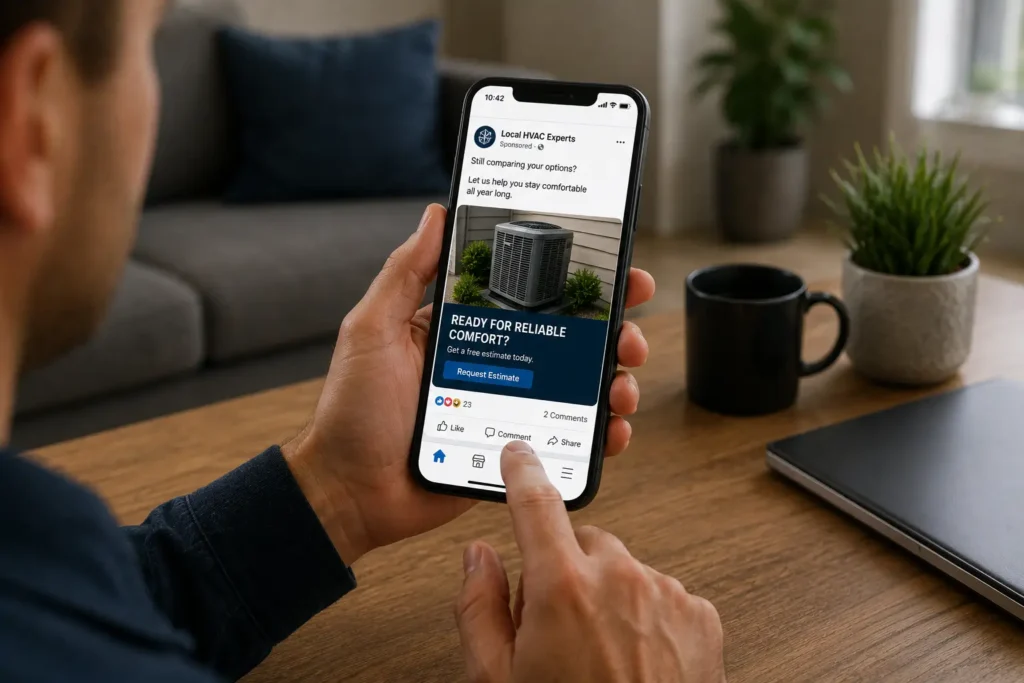
This is where many campaigns become lazy.
The visitor already knows you exist.
Showing them:
“We are an HVAC company. Call us today.”
doesn’t add much.
A better retargeting ad gives the homeowner a reason to reconsider your company.
AC Repair Visitor
Still Need Your AC Fixed?
Schedule service with a local HVAC team and get your home comfortable again.
HVAC Replacement Visitor
Still Comparing HVAC Replacement Options?
See your options, available financing, and what to expect before replacing your system.
Financing Visitor
A New HVAC System May Be More Affordable Than You Think
Explore available financing options and request an estimate.
Trust-Focused Ad
Still Deciding Who to Trust With Your HVAC System?
See why local homeowners choose us for heating and cooling service.
Seasonal Maintenance
Don’t Wait for the First Hot Day to Find Out Your AC Has a Problem
Schedule your seasonal tune-up before demand spikes.
The best ad depends on the page the homeowner visited and where they are in the decision process.
Example HVAC Retargeting Campaign
Imagine an HVAC company gets 2,000 website visitors each month.
Some visit the homepage.
Some read blog posts.
Others visit highly valuable pages such as:
- AC replacement
- Heat pump installation
- Financing
- Emergency repair
- Maintenance plans
Instead of putting all 2,000 visitors into one generic advertising audience, the company could create a high-intent segment around visitors who viewed replacement or financing pages but did not request an estimate.
The campaign could then show:
Ad:
“Still comparing HVAC replacement options?”
Supporting message:
“Get a clear estimate, explore financing, and find the right system for your home.”
CTA:
“Request an Estimate”
Landing destination:
The HVAC replacement page, not the homepage.
That’s an important detail.
If someone originally showed interest in AC replacement, don’t send them back to a generic homepage and make them start over.
Continue the conversation they already started.
How Long Should You Retarget HVAC Website Visitors?
There is no universal retargeting window for every HVAC service.
Think about the buying cycle.
Emergency AC Repair
The decision window may be very short.
Someone with a broken air conditioner in July probably doesn’t need to see the same ad three weeks later.
HVAC Replacement
The decision may take longer.
Homeowners can compare:
- Equipment
- Contractors
- Financing
- Efficiency
- Warranties
- Installation quality
- Reviews
A longer audience window may make more sense.
Maintenance and Memberships
These can have a different timeline again, particularly when seasonality matters.
The principle is simple:
Your retargeting duration should reflect how long the buying decision realistically takes.
Don’t choose an arbitrary window simply because an advertising platform allows it.
Who Should You Exclude From HVAC Retargeting?
More targeting isn’t always better.
Exclude audiences when continuing to advertise to them would waste money or create a poor customer experience.
Depending on the campaign, exclusions could include:
- People who already booked
- Customers who already submitted the target form
- Employees
- Irrelevant geographic visitors
- Job seekers
- Vendors
- Visitors to unrelated content
- People outside your service area
If someone already scheduled the AC repair you’re advertising, continuing to chase them with “Still need AC repair?” isn’t sophisticated marketing.
It’s just annoying.
What Should You Track?
Retargeting performance shouldn’t be judged by clicks alone.
For an HVAC business, the important question is whether advertising contributes to profitable customer acquisition.
Track outcomes such as:
- Phone calls
- Qualified form submissions
- Booked appointments
- Estimate requests
- Cost per qualified lead
- Booking rate
- Conversion rate
- Revenue when attribution is available
You should also know which service generated the lead.
Ten cheap leads for a low-value service may not be worth as much as a smaller number of qualified system-replacement opportunities.
Measure business outcomes, not advertising vanity metrics.
Retargeting Won’t Fix a Bad HVAC Website
This is the part many advertising strategies miss.
Imagine someone visits your HVAC site and leaves because:
- It loads slowly
- The mobile experience is frustrating
- The phone number is difficult to find
- There are weak reviews or trust signals
- The next step isn’t obvious
- The booking form is painful
- The service page doesn’t answer their questions
Now you pay to bring that person back.
But nothing changed.
You’re paying for a second chance to give them the same broken experience.
I’ve seen these problems repeatedly while analyzing HVAC websites. If you’re unsure where the friction is happening, start with my breakdown of the most common HVAC website conversion problems.
That’s why retargeting and conversion optimization should work together.
Before increasing retargeting spend, check whether your website clearly communicates:
What You Do
Visitors should immediately understand which HVAC services you provide.
Where You Work
Your actual service area should be obvious.
Why They Should Trust You
Reviews, certifications, warranties, experience, and other trust signals shouldn’t be hidden near the footer.
What They Should Do Next
Call.
Book.
Request an estimate.
Check financing.
Make the primary action obvious.
Whether the Site Works Well on Mobile
HVAC customers frequently interact with contractors while using their phones.
Buttons, forms, menus, and service information need to work without friction.
Retargeting amplifies the website you already have.
Make sure you’re amplifying something that converts.
If you want to go deeper into why this happens, I’ve also broken down the hidden revenue leak that causes HVAC websites to lose high-intent visitors.
Is Your HVAC Website Ready for Retargeting?
Check what your business already has in place. You’ll get a Retargeting Readiness Score and a recommended next step.
Check each item that is already true for your HVAC business.
Complete the checklist to see your score.
Your result will show whether retargeting is a smart next step or whether your website needs attention first.
Complete the assessment first.
Once you’ve checked everything currently in place, I’ll show you what I’d prioritize before spending more on retargeting.
Find Out Where Your Website Is Losing Leads → HVAC website speed & conversion analysis by Andres Builds

Is HVAC Retargeting Worth It?
It can be.
But not every HVAC company needs retargeting immediately.
If your website gets almost no qualified traffic, building an elaborate retargeting system probably isn’t your highest priority.
If your company already generates website traffic from SEO, PPC, Local Services Ads, social media, or other channels but too few visitors become calls or appointments, retargeting becomes much more interesting.
The strongest strategy isn’t simply:
Get more traffic.
It’s:
Generate qualified traffic → convert more visitors → recover valuable non-converters → measure booked business.
That’s a much healthier growth loop.
Frequently Asked Questions About HVAC Retargeting
What is HVAC site retargeting?
HVAC site retargeting means advertising to people who previously visited an HVAC company’s website but did not complete the desired action, such as calling, booking service, or requesting an estimate.
Is HVAC retargeting the same as remarketing?
The terms are frequently used interchangeably in digital advertising. Platform terminology varies, but both commonly describe strategies designed to reconnect with people who have already interacted with a business.
Can You Retarget HVAC Website Visitors on Google?
Yes. Google Ads supports audience segments built from previous website visitors, subject to Google’s current audience, privacy, and eligibility requirements.
Can HVAC Companies Retarget Visitors on Facebook and Instagram?
Yes. Meta allows advertisers to build website Custom Audiences using website activity when the required tracking is configured.
What HVAC Visitors Should I Retarget First?
Start with high-intent visitors, such as people who viewed replacement, installation, financing, booking, or other commercially important service pages but did not convert.
Should Every Website Visitor See the Same Retargeting Ad?
Usually not. Someone researching AC replacement has different needs from someone reading a maintenance article.
Segmenting audiences allows the ad to continue the conversation the visitor already started.
How Long Should HVAC Retargeting Run?
It depends on the service.
Emergency repairs can have a short buying window, while replacements, installations, and financing decisions can take longer.
Audience duration should match the realistic customer decision cycle.
Does an HVAC Company Need Retargeting?
Not necessarily.
Companies with little qualified website traffic may have higher priorities.
Retargeting becomes more valuable when the website already attracts potential customers but many leave without converting.
Before You Spend More on HVAC Advertising, Find Out Where Your Website Is Losing Leads
If you’re already paying for Google Ads, Local Services Ads, SEO, or social media, generating another visitor isn’t always the first problem to solve.
You may already be attracting enough potential customers.
The bigger opportunity may be what happens after they reach your website.
That’s exactly what my HVAC Website Speed & Conversion service is designed to uncover and improve.
I look for conversion problems involving:
- Mobile usability
- Website speed
- Trust positioning
- Service-page structure
- Calls to action
- Booking friction
- Lead recovery opportunities
Find Out What’s Costing Your HVAC Website Calls
I’ll personally review your HVAC website and identify the biggest opportunities to turn more of your existing traffic into calls and bookings.
No generic automated score.
No unnecessary redesign.
No 40-page marketing report you’ll never use.
Just a focused review of what’s getting in the way of conversions.